
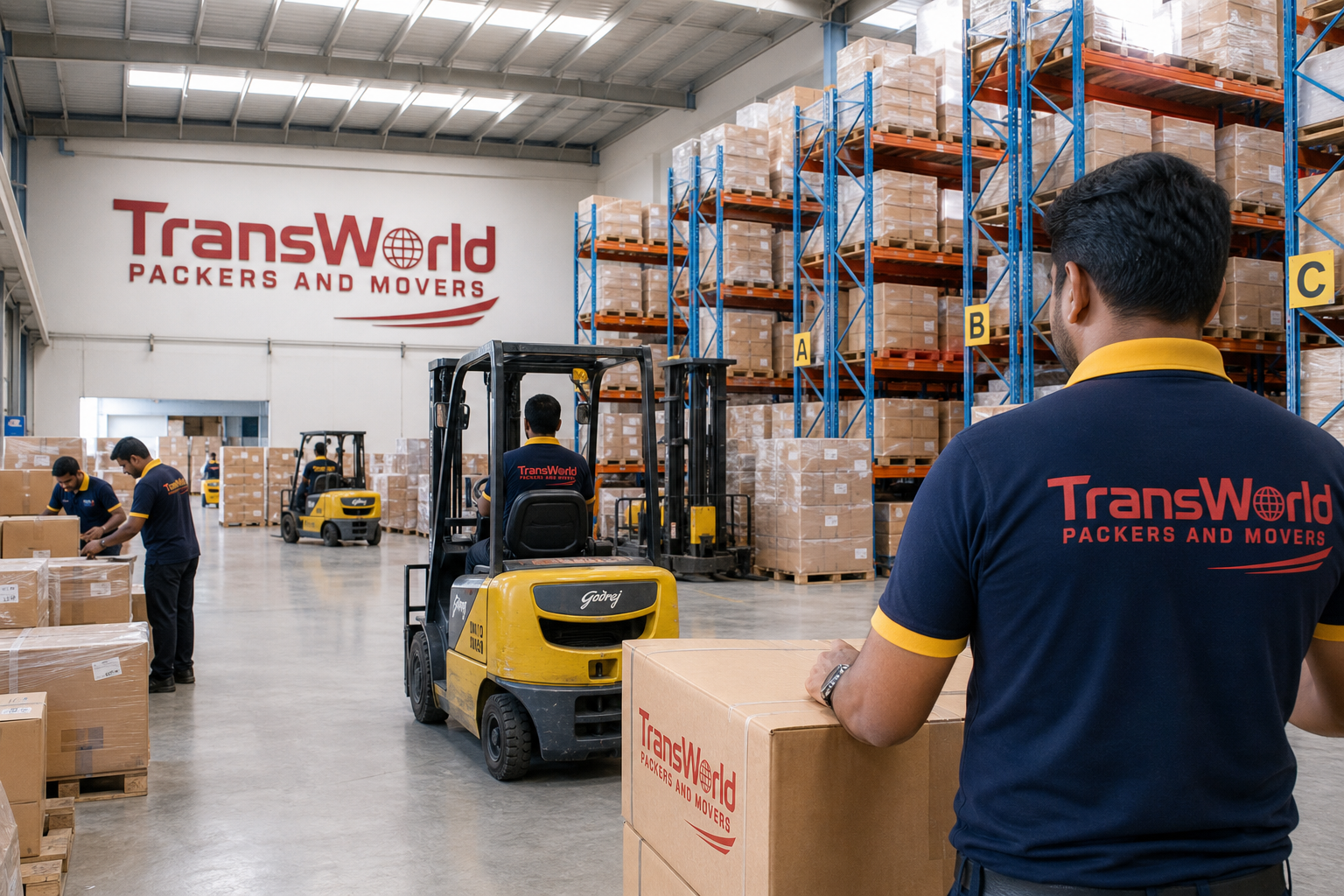
TransWorld warehousing services in India provide organised space for household and commercial goods, with inventory handling and optional transport for inbound and outbound movement.
Why Choose TransWorld for Warehousing Services?
Organised Space
Goods stored with labeling for easy access.
Commercial Friendly
Suitable for stock holding and project storage.
Transport Link
Connect warehousing with pickup and delivery.
Flexible Tenure
Short project storage or longer holding periods.
What Our Warehousing Services Covers
Service options tailored to your requirement:
Household Warehousing — Furniture and cartons held during relocation gaps.
Commercial Warehousing — Stock and materials for business needs.
Project Storage — Temporary holding during office or fit-out work.
Inbound / Outbound — Linked transport for store-in and store-out.
How Our Warehousing Services Process Works
1. Share volume & tenure
Estimate space and storage duration.
2. Inbound planning
Packing and pickup schedule if required.
3. Store securely
Goods placed and recorded in storage.
4. Outbound delivery
Retrieve and transport when needed.
Warehousing Services Cost Guide
| Service Type | Local Shifting Charges | Domestic Shifting Charges | International Shifting Charges |
|---|---|---|---|
| Warehousing and Storage Services | ₹1,500 – ₹15,500 | ₹5,500 – ₹35,500 | ₹18,500 – ₹1,25,000 |
Rates are indicative. Final pricing depends on distance, volume, floor, lift, packing quality & insurance.
Warehousing Linked to Real Relocation and Business Cycles
Warehousing services help when goods must be held with process, not improvisation. TransWorld Packers and Movers supports household holding during possession gaps and commercial holding for project or stock needs, with inbound and outbound transport options that keep the chain under one coordination desk.
Good warehousing is about inventory discipline: what entered, where it sits, how it is labelled and how it leaves. That discipline saves time when multiple retrievals are needed across weeks. Unlike pure long-term industrial warehousing for bulk commodities, our relocation-linked warehousing focuses on mixed household and light commercial lots that must remain identifiable and retrievable.
Project teams storing materials between fit-out phases, retailers buffering festive stock, and families mid-renovation all benefit from the same inbound standards — even though their outbound patterns differ.
Warehousing Cost Components
Pricing reflects space and volume, tenure, handling frequency, labour for inbound/outbound touches and transport add-ons. Project storage for a few weeks differs from longer commercial holding with weekly partial dispatches. We clarify tenure slabs during enquiry so finance and household budgets can plan.
Poor inbound packing can increase handling cost because goods must be restabilised before safe stacking. Frequent ad-hoc retrievals cost more than a planned fortnightly pull schedule. Sharing a forecast of outbound events — even approximate — improves commercial clarity.
Inbound Standards
Goods should arrive packed for stacking. We verify labels, record lots and place items for safe access. Restricted or hazardous goods are not accepted. Customers are guided on packaging expectations before store-in: sealed cartons, covered mattresses, wrapped furniture and no loose sharp objects.
Household lots benefit from room tags; commercial lots benefit from SKU or project-phase tags. Mixed inbound without labels creates outbound delays that frustrate everyone. Photos of high-value pieces at inbound support accountability across the holding period.
Warehousing Users
- Households awaiting new home readiness or renovation completion
- Offices during renovation, consolidation or staggered fit-outs
- Businesses needing temporary stock buffers near demand centres
- Project teams storing materials between construction or interior phases
- Exhibitors holding display goods between event dates
Operational Tips
- Create a simple SKU or room-wise list before inbound.
- Separate items needed within 30 days from long-hold goods.
- Avoid storing perishables, plants and unsealed liquids.
- Plan outbound dates with buffer for transport booking.
- Keep one digital copy of the inventory list accessible to your family or ops lead.
- Flag climate-sensitive wood furniture during enquiry.
- Do not warehouse cash, jewellery or irreplaceable original documents.
Where Warehousing Demand Is High
Metro relocation markets and industrial belts around NCR, Mumbai, Pune, Ahmedabad, Chennai and Bangalore frequently need flexible warehousing paired with transport. Gurugram–Manesar and Bhiwandi-linked flows support both household bridge storage and light commercial buffers. Hyderabad and Chennai see rising demand from IT family relocations overlapping with apartment handover delays.
Secondary nodes such as Nagpur, Indore and Coimbatore use warehousing when intercity household goods arrive before local possession is granted — a pattern that grows as more professionals relocate into these cities.
Outbound Execution
On request we pull listed lots, load carefully and deliver to the destination site. Partial outbound can prioritise bedrooms first and kitchen later, or dispatch only SKUs needed for a store opening. Linked warehousing-plus-transport reduces vendor sprawl and misplaced cartons.
Closing a warehouse tenure should feel as organised as opening it: final inventory check, clean handoff and delivery confirmation. TransWorld warehousing services exist to hold goods with process — so time bought during a move or project does not become inventory chaos.
Household Lots Versus Light Commercial Holding
Household warehousing prioritises room identity, furniture protection and eventual residential delivery. Light commercial holding prioritises SKU clarity, dispatch frequency and sometimes mixed outbound to multiple store addresses. Mixing both styles in one unmarked pile is how project managers lose a week. We ask inbound purpose upfront so placement logic matches retrieval logic.
Interior project teams storing tiles, fixtures and packaged fittings between phases should keep wet-trade materials out and prefer sealed factory packaging. Retail buffers ahead of Diwali need earlier outbound booking than casual household store-outs. Offices mid-renovation should isolate networking crates that may be called back within ten days from archives that can wait until floor handover.
Tenure extensions should be requested before the agreed end date so outbound transport is not double-booked elsewhere. Partial pull-outs work best when inbound labels were disciplined. If you expect weekly dispatches, say so — handling frequency belongs in the commercial conversation. Warehousing linked to TransWorld transport means the people who stored your map are the people who load your next truck.
Inbound Labelling That Makes Outbound Fast
A warehouse is only as useful as its labels. Room tags for homes, phase tags for projects and SKU tags for stock turn holding time into usable time. Unmarked black bags become mystery weight that nobody wants to open under deadline pressure. Photograph inbound rows when lots are large so you remember what “row B” meant three months later.
Climate-sensitive wood furniture should be called out for placement away from damp edges. Mattresses need covers, not bare fabric against dusty floors. When outbound day arrives, we pull by list, not by memory. That is the operational promise of relocation-linked warehousing: hold with process, release with the same map, deliver with the same desk that understood your constraints from day one.
Whether you are bridging a Gurugram possession delay or buffering project fittings between interior phases in Pune, the warehouse stage should feel boringly organised. Ask for tenure clarity, inbound photos and an outbound transport reservation as soon as your next address date firms up. That is how warehousing stays a solution instead of becoming a second problem.
Phase Tags, Dispatch Frequency and Tenure Extensions
Relocation-linked warehousing only works when inbound purpose matches outbound rhythm. Household lots need room tags; project lots need phase tags; stock buffers need SKU tags. Mixing those languages in one unmarked pile is how managers lose a week hunting fittings under winter quilts. Photograph inbound rows for large lots so “row B” still means something months later.
If you expect weekly dispatches, declare handling frequency during commercial discussion — ad-hoc pulls cost more than a planned fortnightly schedule. Interior teams storing sealed fixtures between phases should keep wet-trade materials out. Retail Diwali buffers need earlier outbound booking than casual household store-outs. Offices mid-renovation should park networking crates for ten-day recall separately from archives that can wait until floor handover.
Request tenure extensions before the agreed end date so outbound transport is not double-booked elsewhere. Climate-sensitive wood belongs away from damp edges; mattresses need covers, not bare fabric on dusty floors. When outbound day arrives, pull by list, not memory. Whether bridging a possession delay or buffering project fittings, TransWorld warehousing should feel boringly organised — hold with process, release with the same map, deliver with the same desk.
Exhibitors holding display goods between event dates should tag crates by show name and city so outbound pulls never open the wrong booth set. Secondary nodes such as Nagpur and Coimbatore increasingly need bridge warehousing when household trucks arrive before local possession — plan that hold as a named stage, not an afterthought. Keep one digital inventory copy with your ops lead or family coordinator. Closing tenure with a final inventory check and delivery confirmation is how warehousing stays a solution rather than a second relocation problem.
Ready to move? Call +91-9880234900 for a free survey and written estimate for Warehousing Services. Get a free quote or call now.
Frequently Asked Questions
Is warehousing only for businesses?
No. Households also use warehousing during relocation or renovation.
Can you transport goods to the warehouse?
Yes. Inbound and outbound transport can be arranged.
How is warehouse pricing decided?
By space/volume and storage duration, shared in a written estimate.
Can I access my goods midway?
Access can be arranged with prior notice based on storage terms.